
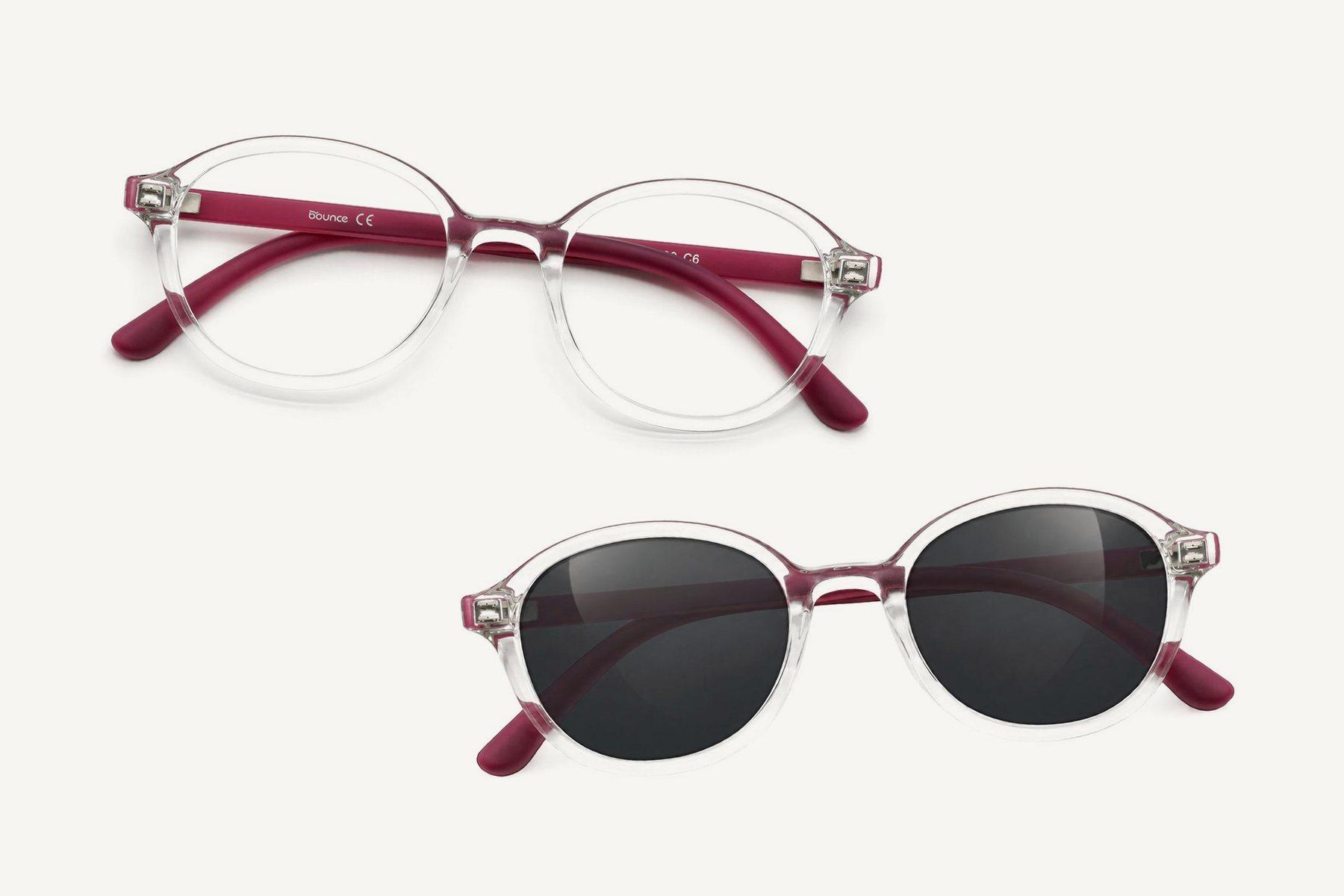
What photochromic means
Most people call them color changing glasses, which is the clearest name for them. A photochromic lens contains a compound that changes shape when ultraviolet light hits it, and changes back when the light goes away. More UV, darker lens. It is a chemical reaction rather than a coating or a filter, which is why it happens gradually and why it reverses.
Transitions® is a brand of photochromic lens, not a different technology — the way Hoover is a brand of vacuum cleaner. Most people use the word for the whole category, opticians included, and nobody minds.
A windscreen blocks the thing that makes them work.
Laminated car windscreens block almost all UV — that is what the lamination is for, and it is why one arm gets sunburnt on a long drive and the rest of you does not. A standard photochromic lens sitting behind that glass never receives the trigger, so it stays more or less clear in bright sunlight while you are driving.
Nothing is broken. The lens is doing exactly what it is designed to do, in an environment that removes its input. It is worth knowing before you buy rather than after, because it is the point at which most people decide transitions were a waste of money.
The two we sell, and what separates them
| Type | Behaves like | In a car | Added to the frame |
|---|---|---|---|
| Signature | Clear indoors, dark outdoors. Blocks UVA and UVB. | Barely reacts | $125 |
| XTRActive® | Darkest outdoors, and keeps a slight tint indoors. Responds to visible light as well as UV. | Works | $175 |
Both come in 2 colors — Gray and Brown. XTRActive responds to visible light rather than UV alone, which is the whole reason it reacts behind a windscreen, and also why it never goes fully clear indoors. That residual tint is the trade.
Photochromic is not polarized
These get confused constantly and they solve different problems. Photochromic controls how much light gets through. Polarization filters light that has bounced off a flat surface — water, wet road, snow, a car bonnet — which is what glare is.
So a photochromic lens on a bright day by a lake still lets the glare through; a polarized one cuts it but does not change with the light. They are independent properties and some lenses have both.
We sell polarized as an option on any sun lens. $29 on a plain tinted pair, $114 with a prescription in it — the gap is real work rather than margin, because the polarizing film has to survive being surfaced to a prescription and stay aligned through it, and a lens that comes out with the axis off is scrap.
If the problem you are solving is water, wet roads or snow, that is the lens to look at rather than transitions.
Are they right for a child?
The honest case for them is one pair instead of two. A child who needs glasses and also needs protection outdoors is a child carrying two pairs, swapping between them, and losing one — usually the sun pair, usually at school. Transitions remove that problem entirely, and for a lot of families that is worth more than optical perfection.
The honest case against is cost and darkness. A dedicated prescription sun pair costs $49 on top of the frame against $125 for transitions, and it is properly dark rather than partly dark. If what you actually want is sunglasses, buy the sunglasses — they are $76 cheaper and better at it.
Two more things worth expecting. They clear more slowly than they darken, so there is a minute of being slightly tinted after coming indoors. And they react more strongly in the cold, so a winter playground makes them darker than a summer one.
What we would do
For a child who is outdoors constantly and loses things, transitions. For a child who mostly needs glasses for school and sun for vacation, a separate prescription sun pair, which is cheaper and darker. For a family doing a lot of driving, XTRActive or nothing — a standard photochromic will disappoint you specifically in the car.
Either is chosen in the lens step on any frame we make, so the decision comes after the size rather than before it. Frames start at $95 complete with prescription lenses, from 110mm across the front.